
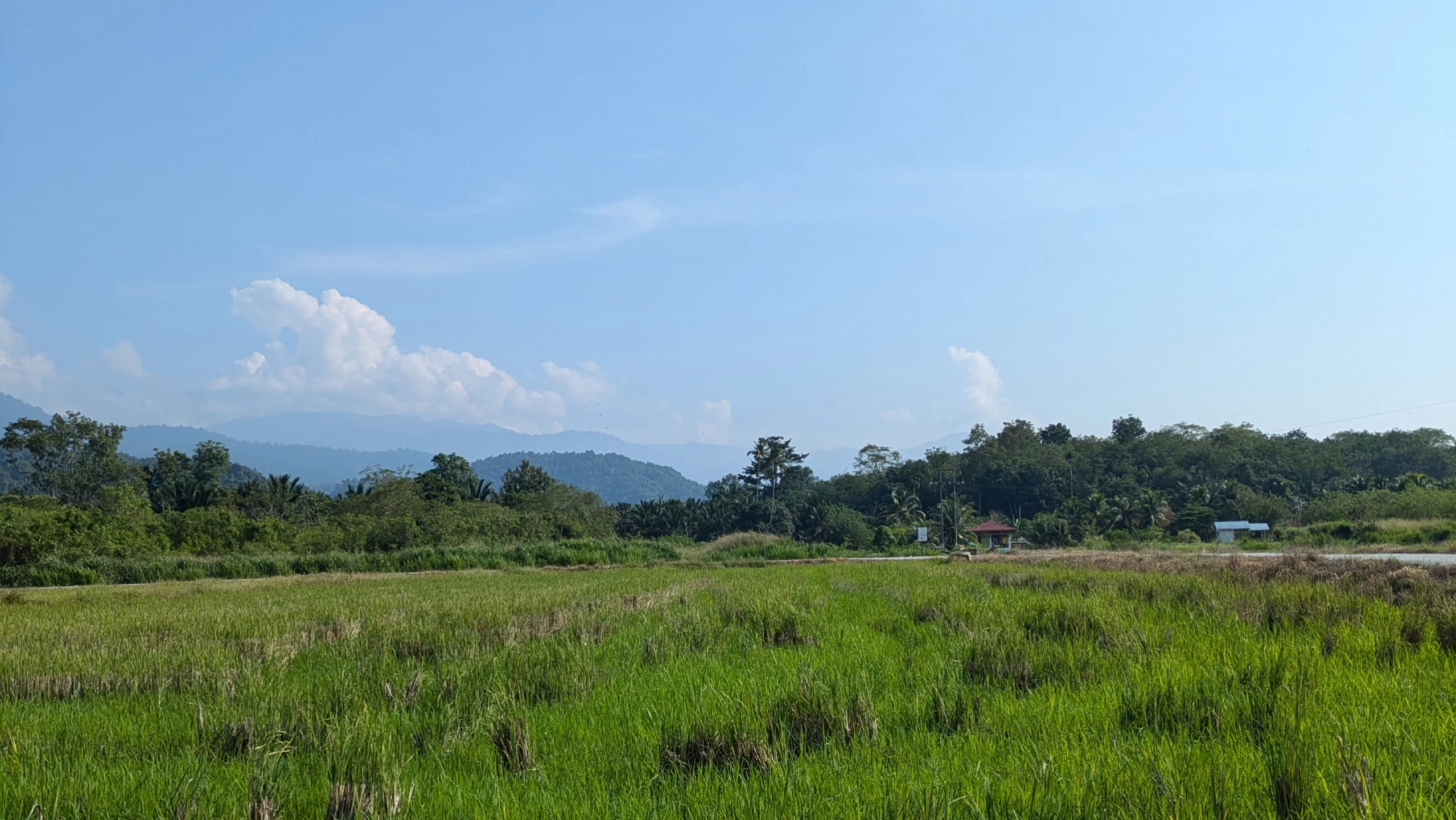
Explore the hidden gem Lenggong Valley and get to know the real Malaysia
Traveling to Malaysia, I absolutely wanted to do a homestay in the rural part of the country. Having worked in community tourism in Peru myself, I was excited to gain more insights into it in another country. So, I ended up at Rumah Tiang 16 homestay in Lenggong. And I have to say, in these 3 days, I learned more about Malay culture than in the rest of my trip combined.
Read all about the homestay experience and Lenggong’s UNESCO heritage site, hidden in a stunning rural region of Malaysia.
Here, you can get directly to the videos about the experience.

Arrival at Nash’s homestay in Lenggong
If you choose to visit Rumah Tiang 16 in Malaysia, look forward to meeting your local, Malay guide Nash. He will welcome you at his beautiful home in Lenggong, where you will spend the next two nights. (Note that shorter stays are possible, but I would recommend the long version.)
Although Nash is originally from the area, he spent a lot of time discovering new places abroad before eventually returning to his roots. His growing awareness of Lenggong’s unique character and his pride in the region and its people led him back home, where he became a pioneer in developing tourism in the Lenggong Valley. The latter had been designated a UNESCO site in 2012 thanks to its archaeological significance.
Next to Nash, I met Daniel, a videographer who was going to film my stay, and Kak Mah, a local woman aspiring to become a guide. Not only did she learn from Nash during our stay, but she also played a vital role in balancing the man-woman ratio of our little group. As a woman, traveling alone with one or two local men would be culturally problematic, especially in such a rural part of Malaysia.
When Nash explained this to me, my thoughts took me back to my arrival experience on the local bus. The further I got from Kuala Lumpur, the fewer women I encountered on public transport, especially those traveling alone. At the end of the journey, I was the only one left, next to the men. Therefore, I totally understand Nash’s reasoning.

All about locally sourced food
After arriving, it won’t take long until the first culinary experience is on the agenda. Usually, I am not a “foodie” at all, and I don’t really bother with what I eat. Therefore, it’s even more surprising that I’m bringing the subject up first. But the variety of dishes, vegetables, spices and cooking methods I learned about at the homestay really impressed me.
Every time we ate, my companions explained every single dish on the table (Or on the floor, where we would eat at Nash’s home). I made an effort to try out all of it, from veggies to eggs and even some meat and fish, which usually isn’t part of my diet. Although they prepared vegetarian alternatives for me I felt it was polite to try a bit of every dish, as the food reflects a significant part of Malay culture.
Sadly, I was a very slow eater, as we were eating with our hands. The food was so good that I was desperately wishing for some cutlery most of the time; I would have eaten everything up in 5 minutes. I hope they know that I ate less just because I couldn’t keep up with them.
In any case, I love the way eating is not just a means to an end. Instead, it’s about the people who prepare it, coming together and cherishing local production and a healthy lifestyle. During mealtimes, you’ll learn a lot about the Malay culture.

The rural communities of Lenggong
Continuing the tour, you will meet many local families throughout Lenggong Valley. Visibly, Nash cares not only about his region but also about the people who live there. With his tour, he found a way to integrate many community members and give back by generating extra income for them.
Not only is this what community tourism is really about, but it was also the most enjoyable part of the tour, in my opinion. I think it’s still not easy to have genuine, extended interactions with local people on a holiday. That’s why meeting new community members every day was special to me, whether it was having lunch at a local family’s place, learning about Malay traditional games, or going for a boat ride.
The locals were always curious. “Are you married? Why are you not married?” was the typical question I would get from them. In a different context, I’d be offended by such a question, wondering why people care more about my relationship status than my personal interests and talents.
But I understood quickly that in rural Malaysia, family means everything. Being together, caring and supporting each other is what matters most here. And that is far from being a bad thing.

Lenggong’s UNESCO heritage site and its rural surroundings
As I already admitted, I was all focused on the homestay experience, rural life in Malaysia and the Malay culture during my stay at Nash’s. Nevertheless, I don’t want to downplay the archaeological significance of Lenggong Valley.
The area became a UNESCO site because it’s one of the oldest records of early human activity outside of Africa and offers an unusually continuous timeline of prehistoric life. The famous Perak Man’s skeleton was found here, Asia’s most complete skeleton from the Palaeolithic era, dating back 11.000 years.
During your tour, Nash will take you to numerous sites throughout the valley, each one a piece of a puzzle that will ultimately form a big picture. I believe that his passion and knowledge of the history of this site are enormous, and I could feel how important it was for him to pass this knowledge on to me and make me understand everything.
Sometimes, I would wander off a little bit, as I was so amazed by the beautiful surroundings. On our journey through time, we passed caves, rock formations, lakes, forests and rice fields. Sadly, we spent a significant amount of time in the car, which is necessary to reach each destination on the timetable. As a passionate ‘walker’, I was dreaming of doing some of the distance on foot.
To this day, I really want to go back and go for a stroll through the peaceful rice fields. Most likely, the locals would never understand why I like the idea of walking around in the unforgiving heat. It was just such a quiet and green place, where the world still seemed to be intact. If I went back now, I would plan an extra day to explore some of Lenggon’s surrounding nature.

Palm oil plantations as far as the eye can reach
The stark opposite of intact is the abundant palm oil plantations all over the country. As I was studying forests at Wohllebens Waldakademie at the time of visiting Malaysia, I really wanted to see such a plantation. I wanted to feel the humidity of the soil (which turned out to be zero), the temperatures inside the plantations, and see the palm oil fruit.
Nash, for his part, was super focused and passionate about his archaeological story. Meanwhile, I only had eyes for the palm trees (I am totally exaggerating, of course), and I think he didn’t quite understand my fascination with something so unnatural and unimpressive.
Still, he managed to give me some time to look at the plantations, which finally made me happy. It’s insane to think that these plantations cover 17% of Malaysia . Malaysia and Indonesia have the highest coverage of plantations worldwide, which is the result of our very own consumption back home.
This is not a call for you to stop consuming palm oil. You already know about the importance of how and what we consume. It’s rather an invitation to seize the opportunity when in Malaysia or Indonesia to enter one of these huge plantations, and let the impressions sink in. Then, go into the jungle and do the same. The contrast is shocking.
In case you want to find out more about palm oil and why it might not be just as bad, read the excursus at the end of the page.

Daniel and his hometown, Ipoh
The videographer, Daniel, became a good friend of mine, and I am still in contact with him today. He is very curious about everything and perfectly matches my energy. Luckily, he’s also knowledgeable about his own country (I should take a page from his book, honestly), and the Malay culture and religion. So, whenever we had some spare time in between activities, he explained even more details to me or shared some personal anecdotes.
After the homestay experience, Daniel took me to Ipoh, his hometown, where I got to meet his mum and dad. This was where I learned what Malaysian hospitality means. “Come in, feel at home and have some food” seems to be the motto. Daniel’s mum was so excited about his new European friend, hugged me several times and didn’t let me leave without taking various pictures with me.
Daniel was in a hurry because he wanted to show me around the city. Sadly enough, we had little time, as I already had another train booked. I could see Daniel getting stressed because he wanted me to learn everything about Ipoh in the one hour we had left. This was obviously impossible, and I felt bad that we didn’t have more time together.
What I took from this was the following: Ipoh must absolutely be worth a shot! From what I experienced during my journey, most people didn’t make their way to this city. Even I, traveling somewhat off the beaten path, didn’t have it on my bucket list.
But the way Daniel couldn’t hold his breath with historical and cultural stories from his town was the best advertisement for Ipoh. Don’t miss out on it when going to Malaysia, and find yourself a Malaysian travel buddy (possibly from a homestay?) who loves their hometown.
Is Rumah Tiang 16 for you?
Malaysia has a good deal of destinations to offer, and if you only have a few weeks available, you’re going to have to choose. Personally, I skipped some very well-known places like Georgetown, Langkawi and the Perhentian Islands. I am grateful my way took me to Lenggong, Ipoh and Pangkor Island instead.
Here, I had the opportunity to experience the real local life of rural Malaysia and learned a lot about the country and its people. If you are done with Airbnb’s, want to mingle with the people, dive deep into the culture and get answers to your questions about Malaysia, Rumah Tiang 16 homestay is for you.
As mentioned before, I would have even spend extended time in the area of Lenggong if I had known better. You will most probably need to hire a car to do so. Nash will surely be able to advise you on this.
Videos about the homestay experience
My personal experience:
Official advertising video:
(Both videos have been created by Daniel Chew.)
Excursus: How bad is palm oil really?
You probably know that palm oil is a major threat to the environment. In fact, it is the biggest threat to orangutans at the moment. However, we consume it in masses. Palm oil can be found in every second product in our supermarkets and we can hardly imagine life without it.
Indonesia and Malaysia are the biggest producers of palm oil, providing 85% of the world’s demand. Consequently, more and more of their jungles are converted into plantations.
None of us likes hearing that. So, what can we do? Should we boycott palm oil and renounce half of the products we buy? The answer is more complicated than you might have thought. The clue is, any alternative to palm oil is even worse. Soy, sunflower oil, and rapeseed plantations can deliver only a fourth of the production that a palm oil plantation can. They consume even more space for the same amount of oil.
As you can see, the solution is not here yet. But this doesn’t mean we should keep calm and continue buying whatever we want while waiting for the solution to arrive. What we can do is reduce our consumption of processed foods: Kit Kat, deep-frozen pizza, you name it. These products contain a significant amount of palm oil, and, honestly, they are not really the healthiest choice anyway.

(Note: I’m not affiliated with the homestay mentioned – this mention is entirely unpaid and independent.)